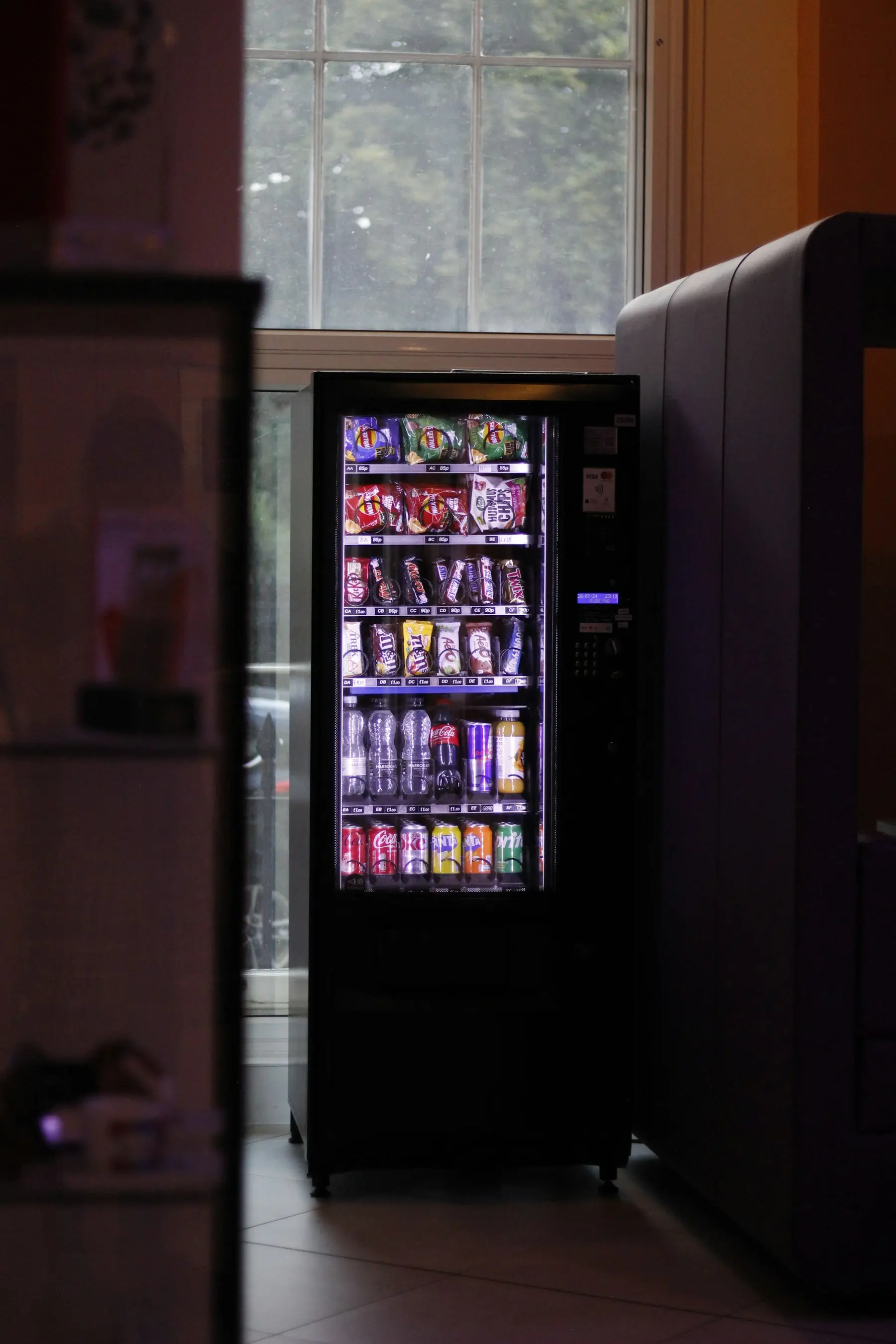
In California, cold food sold through a vending machine is taxed on 33% of what the machine takes in. Carbonated drinks and non-food items are taxed on 100% (CDTFA Regulation 15744). Prices are treated as already including the tax, so you back it out when you file (CDTFA Publication 1182).
On $500 of snacks in San Diego that works out to $12.47 of tax. The rules are in the CDTFA’s Regulation 1574 and Publication 118.
What is taxable
From Regulation 15744:
| Product | Taxable share of receipts |
|---|---|
| Cold food: chips, candy, juice, still bottled water | 33% |
| Hot coffee, tea, hot chocolate | 33% |
| Carbonated drinks | 100% |
| Hot prepared food, other than hot drinks | 100% |
| Non-food items | 100% |
| Food sold for 15 cents or less | Not a retail sale; you pay tax on your purchase price instead |
| Bulk vending at 25 cents or less | Not taxable |
| Purified water into the customer’s container | Exempt |
The 33% figure has applied since 1990. It was 77% in 1988 and 55% in 1989.
“Bulk vending” means a machine holding unsorted product that dispenses roughly equal portions at random, such as a gumball machine. Drinks and hot food are excluded from that definition.
Prices include the tax
Regulation 1574 presumes vending sales are made on a tax-included basis (CDTFA4). Gross receipts for tax purposes are what the machine took in, less the tax inside that amount.
Publication 118 warns that an operator who reports the machine’s full takings as taxable sales, without deducting the included tax, overpays (CDTFA2).
The factors
The CDTFA publishes a factor for each tax rate (CDTFA3), and the rates below are the ones in effect from October 1, 2026 (CDTFA rates6). Multiply receipts by the factor to get taxable sales, then multiply taxable sales by the rate.
| City | Rate from Oct 1, 2026 | Factor, 100% taxable | Factor, cold food |
|---|---|---|---|
| San Diego | 7.750% | 92.8074% | 32.1771% |
| San Francisco | 8.625% | 92.0598% | 32.0868% |
For any other rate: the 100% factor is 100 ÷ (1 + rate as a decimal), and the cold food factor is 100 ÷ (3.0303 + rate as a decimal).
Worked examples
A machine that took in $400 of snacks and $100 of soda in a month:
| Snacks: $400 × 32.1771% | $128.71 |
|---|---|
| Soda: $100 × 92.8074% | $92.81 |
| Taxable sales | $221.52 |
| Tax due | $17.17 |
| Snacks: $400 × 32.0868% | $128.35 |
|---|---|
| Soda: $100 × 92.0598% | $92.06 |
| Taxable sales | $220.41 |
| Tax due | $19.01 |
The soda is a fifth of the sales and more than 40% of the tax. Product mix changes the bill more than the city does.
The permit and the label
Anyone selling through a vending machine generally needs a seller’s permit from the CDTFA. It is free, though the CDTFA can require a security deposit (CDTFA7). One permit covers all your machines. The operator is whoever stocks the machine and collects the money.
Each machine must carry, in a conspicuous place, the operator’s name, address, and seller’s permit number (CDTFA Regulation 15744).
Records
Regulation 15744 requires:
- the location and serial number of each machine;
- purchases and inventories;
- prices;
- gross receipts for each location;
- receipts from exempt sales.
Keep cold food and fully taxable sales as separate lines, since they use different factors. An operator with machines in more than one county files a schedule with the return that splits the tax by county (CDTFA Regulation 15744).
Where smart coolers do not fit
Publication 118 defines a vending machine as one that dispenses an item on payment. It says an item the customer can reach before paying, or that is not dispensed immediately after payment, “is not considered to be sold through a vending machine” (CDTFA Publication 1181).
A smart cooler unlocks first and charges after the door closes. Read literally, that puts it outside the vending machine rules and under the ordinary retail food rules, where cold food sold to go is generally exempt unless the 80-80 rule in Regulation 16035 applies.
We did not find a CDTFA ruling that addresses smart coolers. Ask the CDTFA for written advice on how to report them, and keep the answer.
How another state does it
New York also expects tax to be included in the vend price. Its exemptions are by price: candy and similar items are exempt at $1.50 or less in a cash-only machine and $2.00 or less in a machine that takes cards. Hot drinks are always exempt (NY ST-2808).